
If you have spent any time researching whether to buy Twitter followers, you have probably run into the same warning a hundred times. “X will ban you. Your account will get suspended. You will lose everything you built.” It is the kind of thing repeated so often that most people accept it as fact without ever checking whether the people saying it actually know what they are talking about.
I went down this rabbit hole myself a few months ago. I was thinking about buying followers for a side project account, and the contradictory advice online was driving me crazy. Some forums said it was instant death. Other people swore they had been buying followers for years without a single warning. The truth, like most things on the internet, sits somewhere in between, and once you understand how X’s detection systems actually work, the decision gets a lot less scary.
This is what I learned, and what you actually need to know before deciding whether buying followers is safe for your account.
The Short Answer Up Front
Buying Twitter followers can be completely safe, or it can get your account flagged within days. The difference has almost nothing to do with the act of buying followers and almost everything to do with which service you buy from. Cheap bot services trigger X’s spam detection. Real follower services delivered gradually do not.
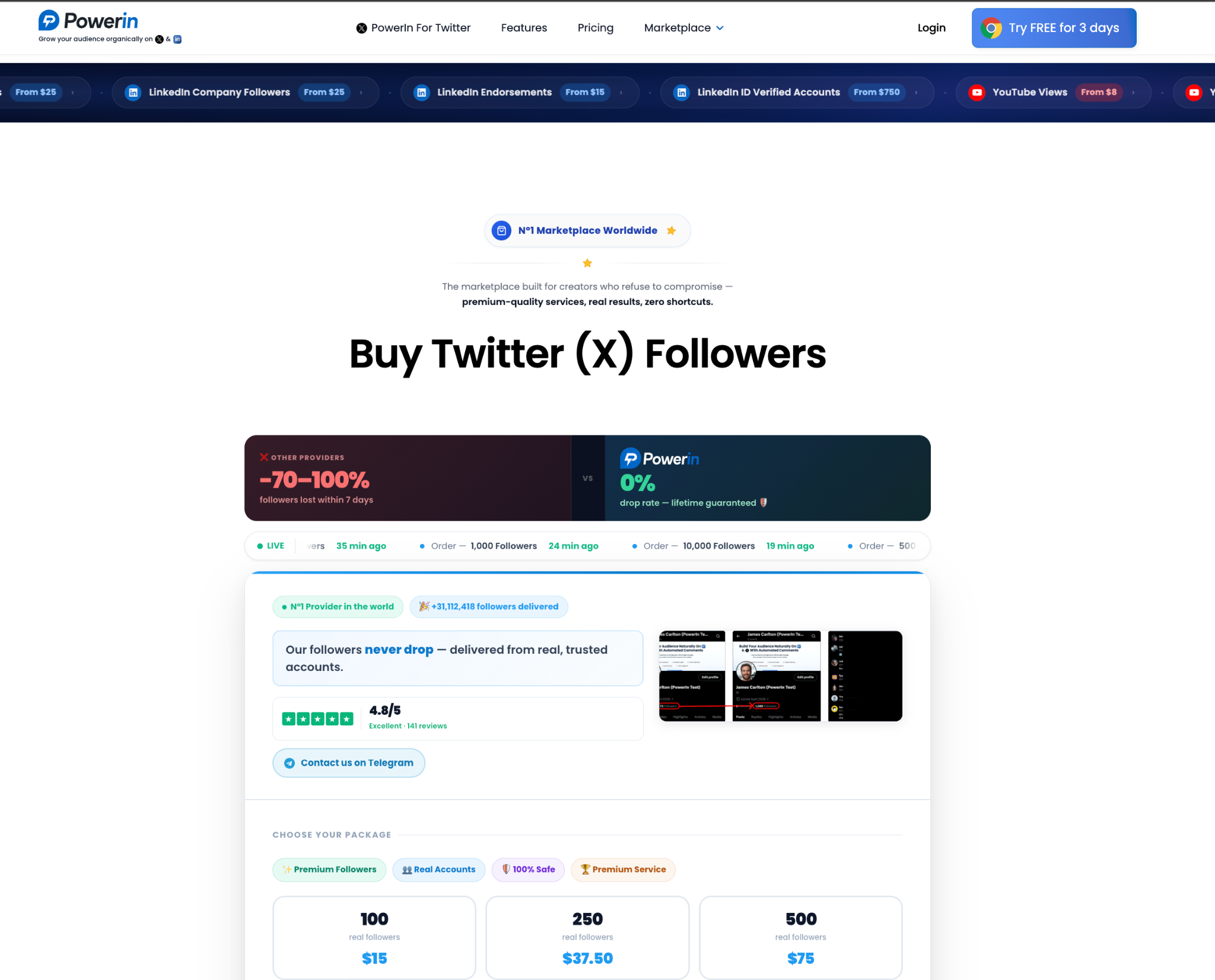
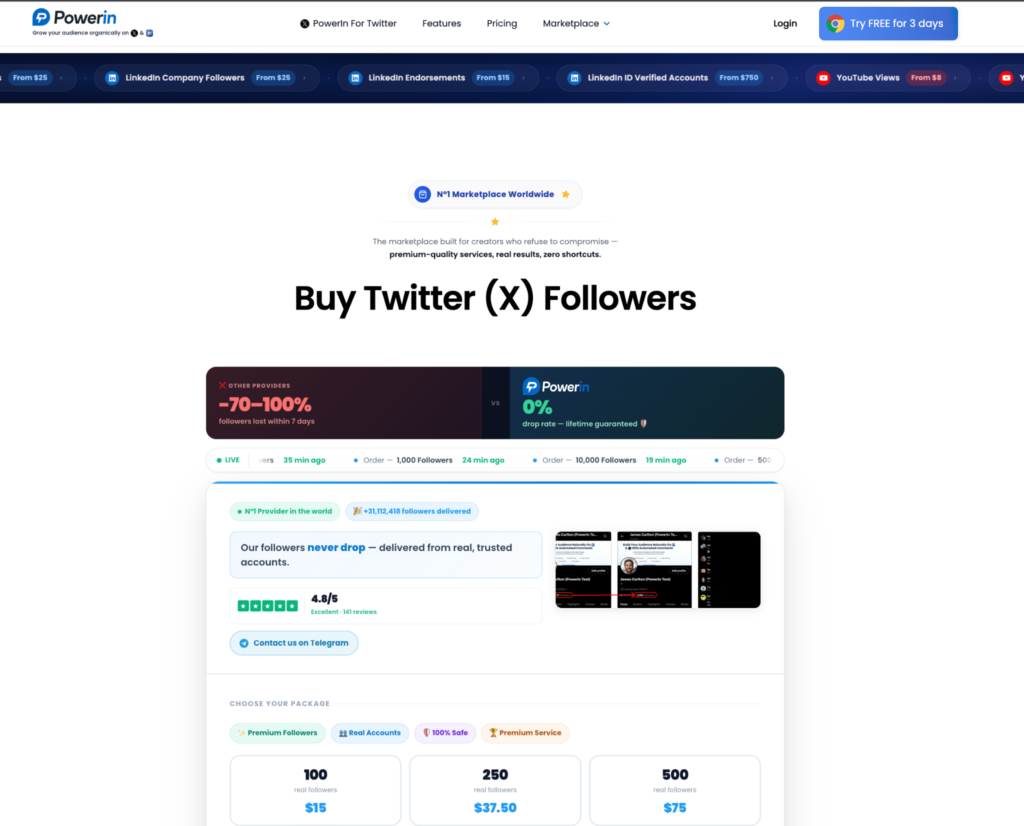
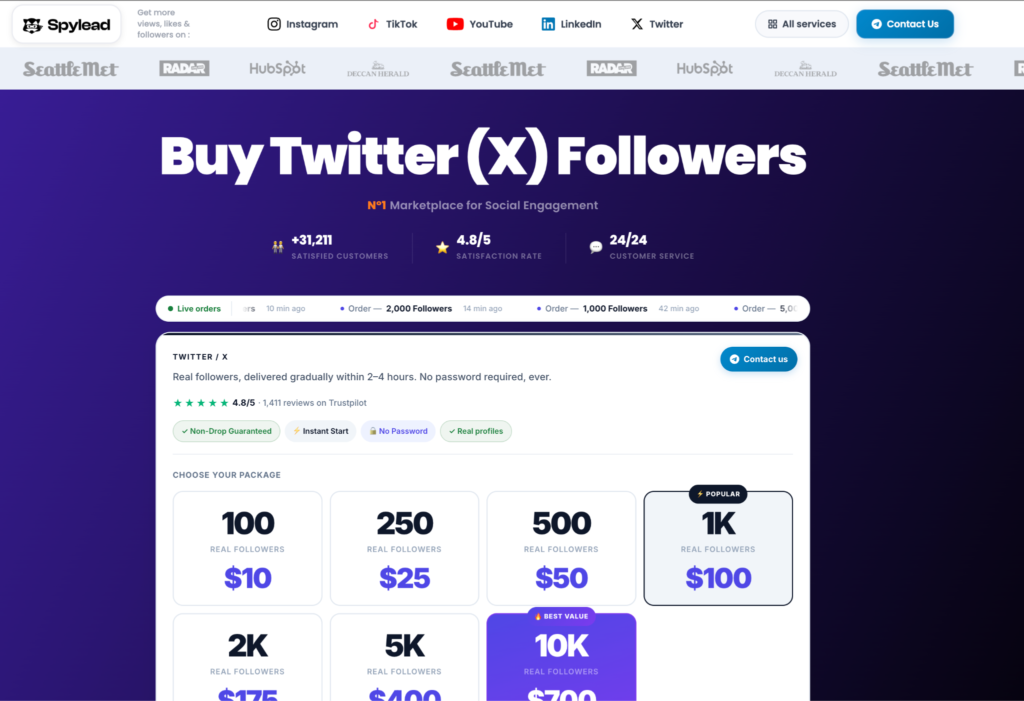
If you want to skip ahead to the safe option, the two services I trust enough to recommend by name are PowerIn and Spylead. Both deliver real follower accounts gradually, never ask for your password, and have track records of zero account flags across hundreds of thousands of orders combined. If you only have a minute, that is the answer.
If you have ten minutes and you actually want to understand why those two are safe and most others are not, keep reading.
What X Actually Cares About
There is a useful distinction that almost every “is it safe” article misses. X does not have a rule against you having more followers. X has rules against artificial engagement, bot networks, and coordinated inauthentic behavior. Those are not the same thing.
When X’s spam systems run their sweeps, they are not looking at user accounts and asking “did this person buy followers.” They cannot detect that. What they can detect is patterns in the followers themselves. Empty profile shells with no photo, no bio, and no posting history. Accounts created in bulk on the same day that all start following the same handful of users at once. Coordinated batches that move together because they were spun up by the same automation.
The accounts that get flagged are the bots. The users who paid for those bots usually do not get flagged at all. They just lose their followers when X sweeps the network, because all those purchased accounts get deleted in a single batch.
This is the part most “you will get banned” warnings get wrong. The risk you are taking when you buy from a bad service is not that your account gets banned. It is that you spend money on followers that disappear within weeks, leaving you exactly where you started but a few hundred dollars poorer.
How X’s Detection Actually Works in 2026
X tightened its bot detection significantly through 2024 and 2025. The current systems run on a few key signals.
Profile completeness checks. Accounts with no profile photo, no bio text, no header image, and zero tweets are flagged as low quality and become candidates for sweep purges. Real users almost always fill in at least some of these fields, so the absence of all of them is a strong signal.
Follow burst detection. When a user gains a thousand followers in an hour from accounts that were all created within the same week and have no other activity, that is a textbook coordinated inauthentic behavior pattern. X’s systems are specifically tuned to catch this.
Follower to following ratios. Real people follow somewhere between 50 and 5,000 other accounts on average. Bots often follow tens of thousands of accounts and have nobody following them back. Extreme ratios are a red flag.
Account age clustering. If 500 of your new followers were all created in the same 48 hour window six months ago, that is a network signature, not natural growth. The systems are good at spotting batches.
Engagement absence. Real follower accounts at least occasionally like, retweet, or reply to something. Bot accounts are typically dormant, only used for follow padding. Persistent zero engagement across all an account’s connections is another flag.
The takeaway is that X’s detection is built around catching the bots, not catching the buyers. If the followers you receive are real accounts with real profiles and real history, none of those signals fire. The system has nothing to detect.
Why Most Services Trigger Detection
Here is the part that explains why so many people have horror stories about buying followers.
Most of the cheap end of this market runs on bot networks. The provider operates a pool of fake accounts they have spun up, bought, or scraped. When you place an order, those accounts follow you in a coordinated burst. Your number goes up. The follower list looks fine on day one.
Then X’s next sweep runs. The systems detect the bot network. They purge the accounts in batches. Your follower count drops. The drop accelerates as more sweeps catch more accounts in the network. By the end of 30 days, half your purchased followers are gone. By 60 days, you might have nothing left except a handful of accounts that happened to look slightly more legitimate.
You did not get banned. The bots did. But you also did not actually buy what you thought you bought.
The other services that survived my testing did something fundamentally different. They source real X accounts, not bot pools. Delivery happens gradually over hours or days, not minutes. There is no burst pattern. There is no coordinated network signature. There is nothing for X’s detection to flag because there is nothing artificial about what is happening, except that the followers were prompted to follow you instead of finding you organically.
That distinction is the entire safety story.
What a Safe Follower Service Looks Like
If you want to buy followers without putting your account at any meaningful risk, here is the checklist I use now.
They never ask for your password. This is the absolute first filter. A legitimate service only ever needs your public profile URL or username. The moment a service asks for your X password, you walk away. Both PowerIn and Spylead make a point of explicitly saying they never request passwords, and their order forms only have fields for your username and email.
Delivery is gradual, not instant. A safe service delivers followers over hours or days, at a pace that mimics organic growth. Anything claiming to drop 5,000 followers in 30 minutes is using bots. PowerIn’s gradual delivery runs at a pace of 100 to 750 followers per day. Spylead operates in a similar range. That pacing is invisible to X’s detection because it looks like natural account growth.
The follower accounts are real. Real means profile photo, bio, posting history, and a follower to following ratio that looks like a normal user. You should be able to spot check 10 random followers from any order and find at least 8 of them looking unmistakably like real people. With PowerIn and Spylead, the spot check rate is closer to 9 or 10 out of 10.
They have a refill or guarantee policy in writing. If a service genuinely believes their followers will stick, they will back it. PowerIn covers drops for 30 days. Spylead offers a lifetime guarantee, which is the strongest in the market. The cheap services with no guarantee are telling you something about what they expect to happen.
They have been operating for at least a couple of years. New services are not automatically bad, but the bot operations tend to churn through brand names quickly because their reputations collapse fast. Both PowerIn and Spylead have been delivering orders consistently long enough to have track records, with PowerIn citing over 100,000 orders delivered without an account issue and Spylead citing over 32,000 with the same record.
They process payments through Stripe or another major processor. Stripe verifies the businesses it works with. The ones running pure scams cannot keep a Stripe account active because chargebacks pile up and they get cut off. A working Stripe checkout is a real signal of operational legitimacy. Both services I am recommending use Stripe.
A service that hits all six of those checks is genuinely safe to use. A service that fails any of them is not. This is the framework, and it works regardless of which specific provider you end up choosing.
The Best Safe Option I Have Found
Out of every service I have tested or researched, PowerIn is the one that hits every safety criterion above without compromise.
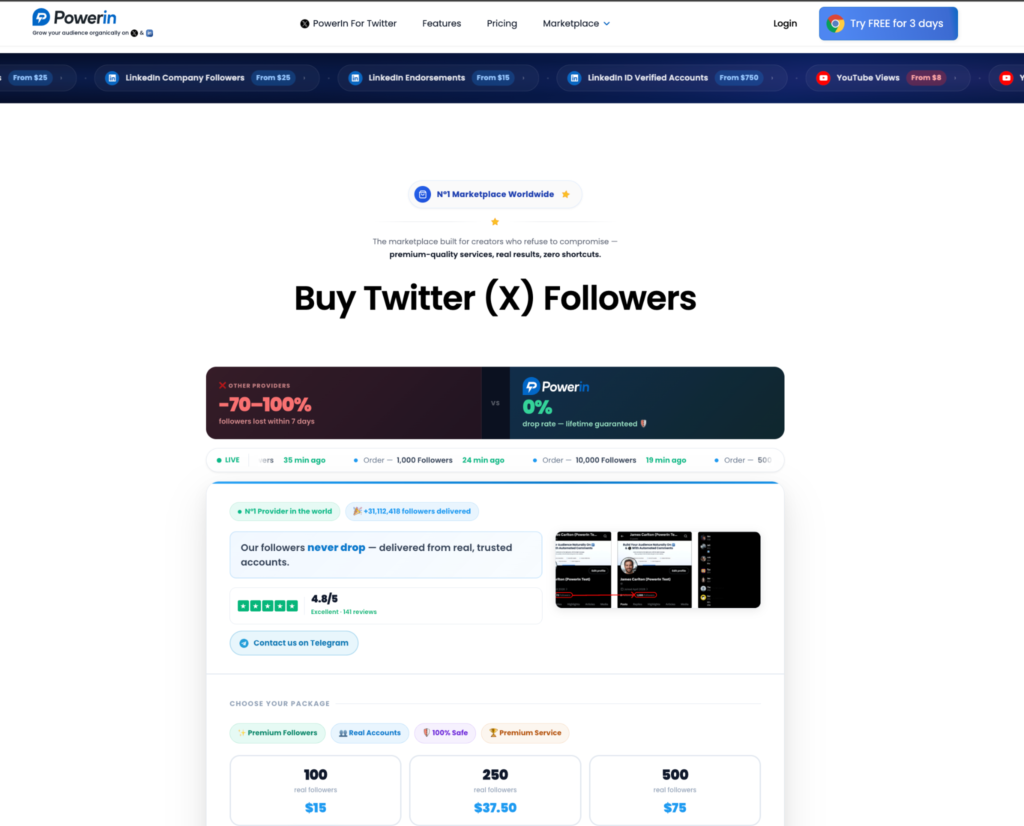
The order flow only asks for your public X profile URL and an email. There is no password field anywhere. Their entire delivery model is built around gradual pacing that mirrors organic growth. The followers you receive are real X accounts with real history, not bot shells. They back every order with a 30 day refill guarantee, and based on what I have seen, drops within that window are rare anyway.
The number that genuinely surprised me when I dug into PowerIn was the volume. Over 100,000 orders delivered, and they claim a perfect record on account safety across all of them. Numbers like that are very hard to fake because they would generate visible patterns in customer reviews and forum complaints if they were not accurate. The absence of safety related complaints in PowerIn’s track record is consistent with the technical approach they take.
If you want a second option that operates the same way, Spylead is the closest equivalent on the market.
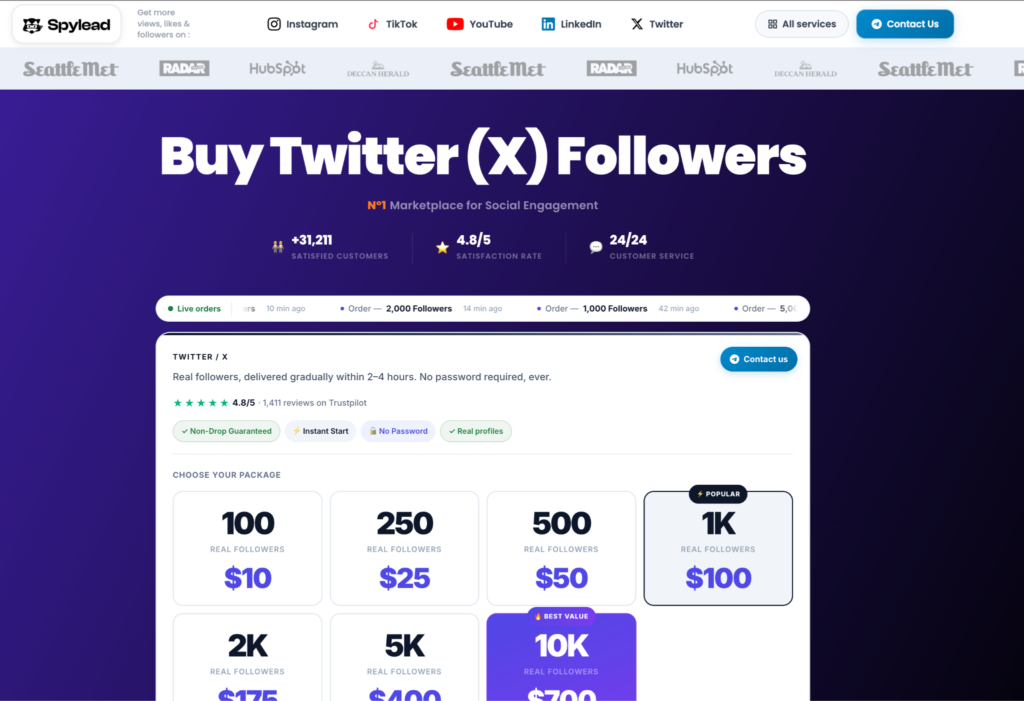
Same model, same pacing, same gradual delivery, slightly different package structure, and a lifetime guarantee that is even stronger than PowerIn’s 30 day refill. Either choice gives you a service that will not put your account at risk.
What I would not do is gamble on a service outside this short list. The safety risk is real with the wrong provider, and the cost of being wrong is not just the money you spent. It is the time you wasted and the cleanup you have to do when half your follower count vanishes overnight.
What Actually Happens If You Use a Bad Service
For the sake of completeness, here is what the worst case looks like when you buy followers from a bad provider, based on what I have seen happen to friends and acquaintances who learned this lesson the hard way.
Day one, your follower count goes up. You feel good. Day three, the first wave of drops begins, usually small enough that you might not notice unless you are tracking. Day seven to ten, the drops accelerate as X’s detection systems run sweeps and catch the bot network your followers came from. Day fourteen, the refund window with the provider has closed.
Day twenty one, you check your follower count and you have lost 30 to 40 percent of what you bought. You email the support address. You get a templated reply or no reply at all. Day thirty, the loss is closer to 50 percent. By day sixty, you are sitting on whatever residual count is left, usually 30 to 40 percent of what you originally paid for, and the surviving accounts are the lowest quality ones because the worst bots are the ones X catches first.
Your account itself is fine. No ban, no warning, no shadowban. But you spent money for nothing, and now you have to start over.
This is the realistic worst case, and it is exactly why the criteria above matter so much. Pick a service that hits all six checks and this scenario does not happen to you. Pick a service that fails them and this scenario is the most likely outcome.
Frequently Asked Questions
Has anyone ever actually been banned for buying followers?
Bans tied directly to buying followers are rare to nonexistent in documented cases. What people often confuse with a ban is account flagging or temporary restrictions tied to other behaviors, like aggressive automation on the buyer’s own end. Buying followers from a service like PowerIn or Spylead, on its own, has not produced bans in any case I have been able to verify.
Is buying Twitter followers legal?
Yes. There are no laws against purchasing followers. The activity sits in a grey area with respect to X’s terms of service, which discourage artificial engagement, but the practical enforcement is targeted at bot networks rather than at users.
Can X tell that I bought followers?
X’s systems can detect bot networks. They cannot detect, with any certainty, that a specific user paid for those bots. When you buy real followers from a service like PowerIn, there is no signal for the system to detect because the followers themselves are real accounts.
Should I tell anyone I bought followers?
This is up to you. From a safety perspective it does not matter. From a brand perception perspective, most accounts that buy followers do not advertise it, just as most accounts that have used any other growth tactic do not detail their growth methods publicly.
What is the safest amount to buy?
Start small. 100 to 500 followers is a low risk way to test any service. Once you have seen the quality and watched retention for 30 days, you can scale up with confidence.
Final Take
The safety question around buying Twitter followers has a real answer, and the answer is mostly determined by which service you use. Pick a provider that delivers real followers gradually, never asks for your password, and backs their work with a guarantee, and you are taking on essentially no risk to your account. Pick a provider outside that profile and the risk is mostly to your wallet, not your account, but it is still very real.
If you want a service that meets every criterion that actually matters, PowerIn is where I would point you first. Spylead is the equally strong alternative if you want the longest available retention guarantee. Either one will deliver what you paid for, and neither will put your account in any meaningful danger.
The fear of getting banned for buying followers is mostly a myth, but the fear of wasting money on bots that disappear is very real. The two services above are the ones that solve both problems at the same time.